MINERAL PARK
The mineral park on the Isle of Elba serves the purpose of remediation and adding ecological value to the areas that were run down as a result of mining. The idea was based on the need to give back to the environment a large region that had been exploited by humans and which, as a result, had changed dramatically. Today, the region relies on new concepts of cultural and educational value that the deserted mines now have to offer to the public. With this park, the community makes use of a lifelike model that encompasses everything that theoretical and specialized texts cannot always explain clearly. The project includes the municipalities Capoliveri, Rio Marina and Rio nell’Elba by giving value to various different cultural aspects and offering mineralogical and archaeological museums to the public in addition to mining art. There is also the opportunity to take a tour through the Rio Marina and Rio Albano above-ground mines and to discover the underground magic found in the Ginevro tunnel in Capoliveri guided by members of the mineral park's knowledgeable staff. Our guests can also take part in the educational activities, such as searching for and examining minerals in the new laboratory for environmental education, an open air amphitheater with room for 700 visitors and offering a picturesque view of the ocean as well as insight into the historic background of Elba’s mines that is portrayed in the archives found in the Palazzo del Burò.
The museum is sprawled on a 600 m2 space inside of the Palazzo del Burò in the old town of Rio Marina. Here is where you can find one of the most important collections of minerals on the Isle of Elba with numerous pieces of unique beauty.
In the inside of the museum, in addition to minerals you can also marvel various different lifelike mining devices set up by industrial archaeological experts. The reproductions were built using original material found in the antique workshops (a blacksmith's workshop, the miners' shelter and a small section of a tunnel, all true to the original size). Old tools and historic photos complete this unique and impressive atmosphere.
The museum Alfeo Ricci in Via Polestro in Capoliveri is home to minerals from various different areas around Elba, however especially from the east, where the mines are located. It offers visitors numerous examples of unique beauty, rarity and scientific value and comprises the complete range of Elba’s minerals. Alfeo Ricci, an extremely versatile human being, dedicated himself from the 1930s to the 1960s to collecting and categorizing minerals from the various different parts of Elba, especially from the eastern mining region. Today, his collection represents a living testimonial to scientific gathering and passionate study of an especially rare mineralogical treasure.
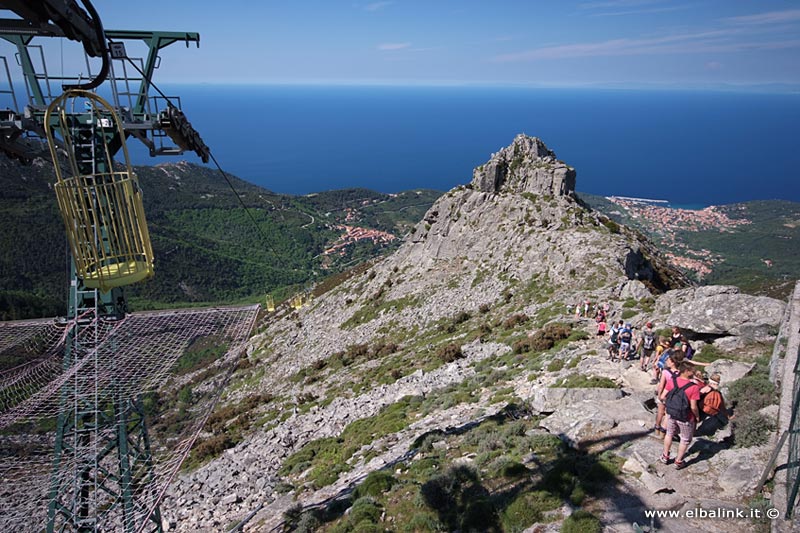
A kind of natural continuation of the museum visit are guided tours planned and carried out by experienced environmental experts that vary in length and are conducted either on foot or on board of a small picturesque train. The tour takes you through the most important mining sites of Rio Marina, Rio Albano and Capoliveri, some of which were already being exploited during the Etruscan and Roman era – an unforgettable excursion through magical colors, lunar landscapes, remains of train tracks and old processing sites.
The tours through the antique mines allow each guest to experience first-hand the various aspects of the world of iron ore on the Isle of Elba and the close relationship between man and minerals.
During the tour, our experienced guides give an explanation of the different mineralogical forms, the mining techniques used during the different periods of time and are ready and willing to answer any other questions you might have.

BOAT TOURS
GLASS FLOOR SHIP NAUTILUS
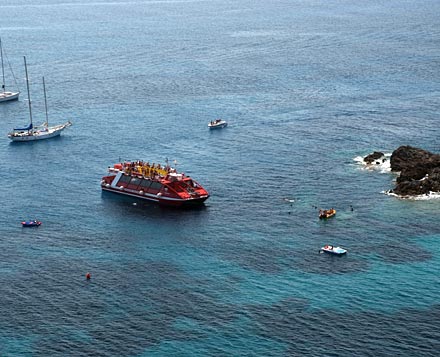
Tours on board the “Nautilus”, the innovative means of transporting passengers, the largest of its kind (24x8 m) on the Mediterranean with room for around 200 – 240 people. On board, you can gaze in wonder at the coast of the Isle of Elba and thanks to the 80 m2 glass surface on the ship’s floor, you can discover the flora and marine fauna of the intact depths of the island.
Departure from Marciana Marina and Portoferraio:
After casting off from Marciana Marina, the tour takes you along the coast to Pomonte, where you can discover the wreck of a merchant vessel that sank in 1972 all accompanied by explanations in Italian.
When leaving from Portoferraio, the tour takes you all the way to Golfo del Viticcio, along the headland Enfola and provides you with a view of the ocean floor of the fabulous marine park “Secche di Capo Bianco". The Nautilus is equipped with a bar and with state-of-the-art navigational instruments that make boat tours relaxing and safe. The passengers also have access to a panorama deck, a covered deck and the room with view to the ocean floor.
The "Nautilus” offers every convenience, air conditioning and stereo system, bar and state-of-the-art navigational instruments that will make your boat trip not only relaxing, but also safe.
SHIP BELUO
Tours to the islands of Pianosa, Capraia, Giglio and Montecristo.
PIANOSA
Pianosa is the fifth largest of the seven islands in the Tuscan Archipelago. It is 13 km south west (SW) of the Isle of Elba. Its surface area measures 10.3 square kilometers and includes a coast line around 18 km in length.
Today, Pianosa is almost entirely uninhabited. Only few people claim the island as their permanent home. (Some carabinieri, the family of a guardsman of the former prison and two or three day release prisoners).
The island owes its name (“Planasia” during ancient times) to the fact that it is almost entirely flat and only shows a slight elevation in some places. The highest elevated area is 29 m and the average height above sea level is around 15 – 20 m.
Pianosa is a part of the Tuscan Archipelago National Park. Fishing and navigation is prohibited in a radius of one mile around the island. Access to the island is subject to a special license issued by the park management.
The island is governed by the municipality Campo nell’Elba in the province of Livorno. Pianosa used to be a penitentiary and a penal colony. In 1858, the “agricultural penal colony of Pianosa” was established and prisoners convicted to “a prison sentence, forced labor and life sentences” were sent to the island, who were all destined to perform work on the fields. In 1861, at the time of the proclamation of the Italian Union, the number of prisoners had reached 149.
In the following year, construction of a building meant to house 350 prisoners was completed, but in 1872, the decision was made to divide the island into several small agricultural production centers, so-called “poderi”, and as a result the prisoners were split up into small communities.
Around 1880, there were close to 960 prisoners confined to the prison of the island. From 1884 on, prisoners from prisons all across Italy, who were infected with tuberculosis, were moved to Pianosa, thus joining those already inhabiting the island and who stayed there until 1965. Treatment to patients with tuberculosis was broken down into three structures: Preventative (today Centrale), where supposedly patients were subjected to initial tests, the sanitarium (ex Podere del Cardon, today Agrippa), a well equipped hospital for treating lung illnesses, the convalescence home (Podere des Marchese), where prisoners who had overcome the illness were sent to spend time for a period of recuperation.
Even Sandro Pertini, the future president of Italy, had been arrested in 1932 for political reasons and was then a “guest” in the Sembolello department. At this time, the height of the presence of civilians on the island, around 60 families lived here.
In the 1980s, from various sides a debate was held to close down the prison and thought was given to return Pianosa to the competent civil authority. As a consequence of the crisis that raged after the judges Falcone and Borsellino were assassinated, however, the government decided to immediately reopen the high-security prison on the island and banished prisoners convicted of mafia crimes to the institution.
These new circumstances changed Pianosa into a fortress that was accessible to everyone, the Agrippa department was separated from the rest of the island. Correction officers, carabinieri and police officers guarded Pianosa day and night. Very strict bans were in place prohibiting aircrafts from flying over the island and navigating ships in its waters.
The state of emergency continued until July 1997 once the last convicted Mafiosi left the island and was brought to a different prison on the Italian mainland. And, once again, there was a debate about closing down Pianosa. It was almost definitely closed down in August 1998, because only a few order personnel remained on the island that was charged with supervising and guarding the structure.
A trip to Pianosa (a stay of approximately 6 hours) offers the opportunity for:
NATURAL SCIENCE TREKKING – A TOUR OF THE ISLAND BY BICYCLE AND/OR CARRIAGE AND/OR BUS.
Tours also include the opportunity to visit the Christian catacombs, the Roman spa resort that was owned by the nobleman Marco Postumo Agrippa and to enjoy a photo exhibition “Coalition for the Protection of Pianosa” during a round trip, which ranges from the Stone Age to the settlement of the first of Italy’s prison colonies in the 19th century.
CAPRAIA
The Capraia Island boasts an exciting and fascinating history. The island was inhabited for the first time towards the end of the 3rd Century BC and was then settled by Phoenicians, Greeks, Etruscans and Romans. It was the seat of an intensive religious reality: When Christianity began spreading through Rome several groups of monks took flight after the Edict of Milan in 313 AD to arrive at Capraia to escape imperial repressions. For centuries, the island was targeted and invaded by pirates and because of this fortresses were built there, first by the Roman Empire, then by the Republic of Pisa and later finally by Banco di San Giorgio. These fortresses can still be seen on the island today (the fortress San Giorgio with the same name as well as numerous defense towers along the coast). These incorporate a fascinating part of the history of Capraia: Saracen pirates, wars, territorial demands all saw Capraia, an island located strategically well, enmeshed in these kinds of events all the time. After almost seven centuries of a climate defined by conquests and constant wars, Capraia became a part of Corsica, was then integrated in the Republic of Genoa, then went to Pisa, to France and finally even to England until after the defeat of Napoleon it was awarded to Sardinia by the Congress of Vienna.
At this time, the famous tobacco factory was established, at the site of which a penal colony was formed by the Italian Empire 70 years later, which, during the era of Fascism was also used as a place where people were “banished”. During both World Wars, Capraia once again played an adventurous role full of stories and anecdotes, but also played a role in becoming home to fallen soldiers and patriots. The prison was abolished in 1986 by ministerial order. Since 1986, the island has become a site within the Tuscan Archipelago National Park.
Capraia Island is located in the middle of the Tuscan Archipelago National Park, a nature reserve that is made up of 18000 hectares of land and 60000 hectares of marine surface. The reason why a national park was established that includes both land as well as the sea is easily understandable: The purity of intact waters, the variety in the sea bed and the coastal areas of each island as well as the presence of numerous shoals make this area a perfect biological habitat for sedentary and migrating marine fauna.
In addition, Capraia has the only natural sweet water lake within the entire Archipelago and thanks to its location in one of the most well-known “faunistic migration corridors” between Africa and Europe, it is a resting and reproduction spot where a large number of a variety of different bird species must land. Capraia also has a significant number of vegetable and animal endemisms. Thanks to its location in the center of the so-called “pilgrimage of whales”, one will undoubtedly encounter groups of dolphins and whales here. The island is therefore a small natural paradise not far from urban cities, an unexpected oasis of wild and fascinating natural treasures, which is most definitely worth a visit.
A trip to Capraia (a stay of approximately 5 hours) offers the opportunity for:
NATURAL SCIENCE TREKKING – KAYAKING - SNORKELING
GIGLIO ISLAND
Isola del Giglio (GR) is a small municipality with a population of a little more than 1500 and is located on the island with the same name in the Tuscan Archipelago (Tyrrhenian Sea), about 16 km from Monte Argentario.
Connection to the mainland is ensured by ferries that cast off from Porto Santo Stefano and which are owned by the shipping companies Maregiglio and Toremar. During the summer months, a small, symbolic fee is paid to access the island with a personal vehicle.
Giglio Porto is located on the east coast of the island and is where boats and ferries coming from the mainland of Tuscany dock.
The village consisting of fishermen houses surrounds the port area and offers a beautiful boardwalk and picturesque alleys that lead to the beautiful Piazza della Dogana, the “living room” of the island. Included amongst the historically interesting architectural monuments is the Saracen tower dating back to the middle ages and the Madonna del Giglio church.
Giglio Castello is located at a higher elevation in the interior part of del Giglio island. The medieval village is characterized by its enormous Rocca Aldobrandesca, a part of the castle complex, as well as the typical, well-maintained walls and several defense towers.
In the medieval Borgo, there are two churches, one of which is dedicated to Saint George and the other to Saint Peter. The second of the two provides safekeeping for the “treasure” of Pope Innocent XIII as well as a magnificent crucifix made of ivory, a masterpiece by Giambologna.
Giglio Campese is a modern holiday location on the west coast of the island located on an expansive stretch of beach in a bay, the southern tip of which borders a row of picturesque cliffs, while the northern part ends at the tower dating back to the 14th century Torre del Campese.
In the vicinity of the defense tower there is a tourist port for smaller boats.
The island has been inhabited since the Iron Age. It later became a military base for the Etruscans and even under Roman rule it was a relatively significant military base in the Tyrrhenian Sea, which was mentioned for example by Julius Caesar in De Bello Gallico and the poet Claudio Rutilio Namaziano. Bordering the Giglio Porto settlement are the remains of the Roman Domizi Enobarbi villa, just somewhat below the water surface: It is made up of an expansive region consisting of a pool with a fish farm in the sea, the outer walls and covered colonnades, what remains of the Opus sectile, mosaics, frescos, a star shaped terrace, buildings located on the seashore with arcades and a long hanging patio. The entire area is called “Castellari of Giglio Porto”.
During the eras that followed, the island was ruled by various different families of noblemen from central Italy and after 1264 by the government of the city of Pisa, which eventually lost the island to the Medici family. During the Middle Ages, it came under the rule of the Aldobrandeschi family, and then became a part of the Perugia community. From 1264 until 1406 it belonged to Pisa, then later to Florence. Not far from the Roman remains, a medieval tower raises high, the so-called “Saracen Tower”. At the end of the beach of Giglio Campese is the defense tower, Torre del Campese, which in the late Middle Ages was built as protection against the Saracens. Today it has been renovated and is a private residence.
In 1544, the famous pirate Khayr al-Din, known as Barbarossa, plundered the island, killed anyone who got in his way and hauled off 700 residents as slaves. After this bloody raid, the Medici family settled people from the Siena area onto the island. The Saracen attacks lasted until 1799.
In downtown Giglio Castello, in a very special place, is Rocca der Medici, which was just recently renovated. In the church San Pietro Apostol in Giglio Castello, you will find a crucifix made of ivory that is attributed to Giambologna.
A trip to Giglio island (a stay of approximately 4 hours) offers the opportunity for: SNORKELING
MONTECRISTO
Montecristo Island is located in the Tyrrhenian Sea and is a part of the Tuscan Archipelago. As far as administrative government is concerned, it belongs to the municipality of Portoferraio and thus to the Livorno province. It is a state nature reserve and a part of the Tuscan Archipelago National Park. The island has always been uninhabited. Today, the only permanent residents are two lighthouse guards and some forest rangers, who trade places each week.
The conditions which have inhibited the island from being populated have on the other hand been favorable for rich flora and fauna.
In Montecristo, animal and plant species live and prosper, which at one time could be found throughout the entire Mediterranean region and which today can only survive here, such as the Montecristo viper (a particular species on this island), the Sardinian discoglossus, an amphibious creature that today only lives on this island or on Sardinia. In addition, the island is a popular resting spot for thousands of migratory birds. Even the ocean is rich in marine life: Posidonia creeping algae carpets, sea anemones, gorgonia and corals, moon fish and also monk seals have been seen here.
Montecristo is the most remote and wildest of all of the Tuscan islands. Attempts at populating the island extend as far back as to the age of the Etruscans and continues into our times, when after the Italian unification attempts were made to colonize a penal colony here. However, every attempt has failed because of the distance to the mainland, the island’s remoteness, the adversity of the soil as well as the difficulties in accessing the island.
Such adverse conditions have lead to countless mysterious legends throughout the centuries, for example such that emphasize the ghostly presences on the island that made it impossible for people to survive or that portrayed it as the secret location where Saracen pirates hid their treasures. Several crucial scenes in the famous novel “The Count of Montecristo” written by the French author Alexandre Dumas (based on which there have also been numerous film productions) play out on this island. The main character finds the legendary treasure here.